Two age-appropriate competition routes
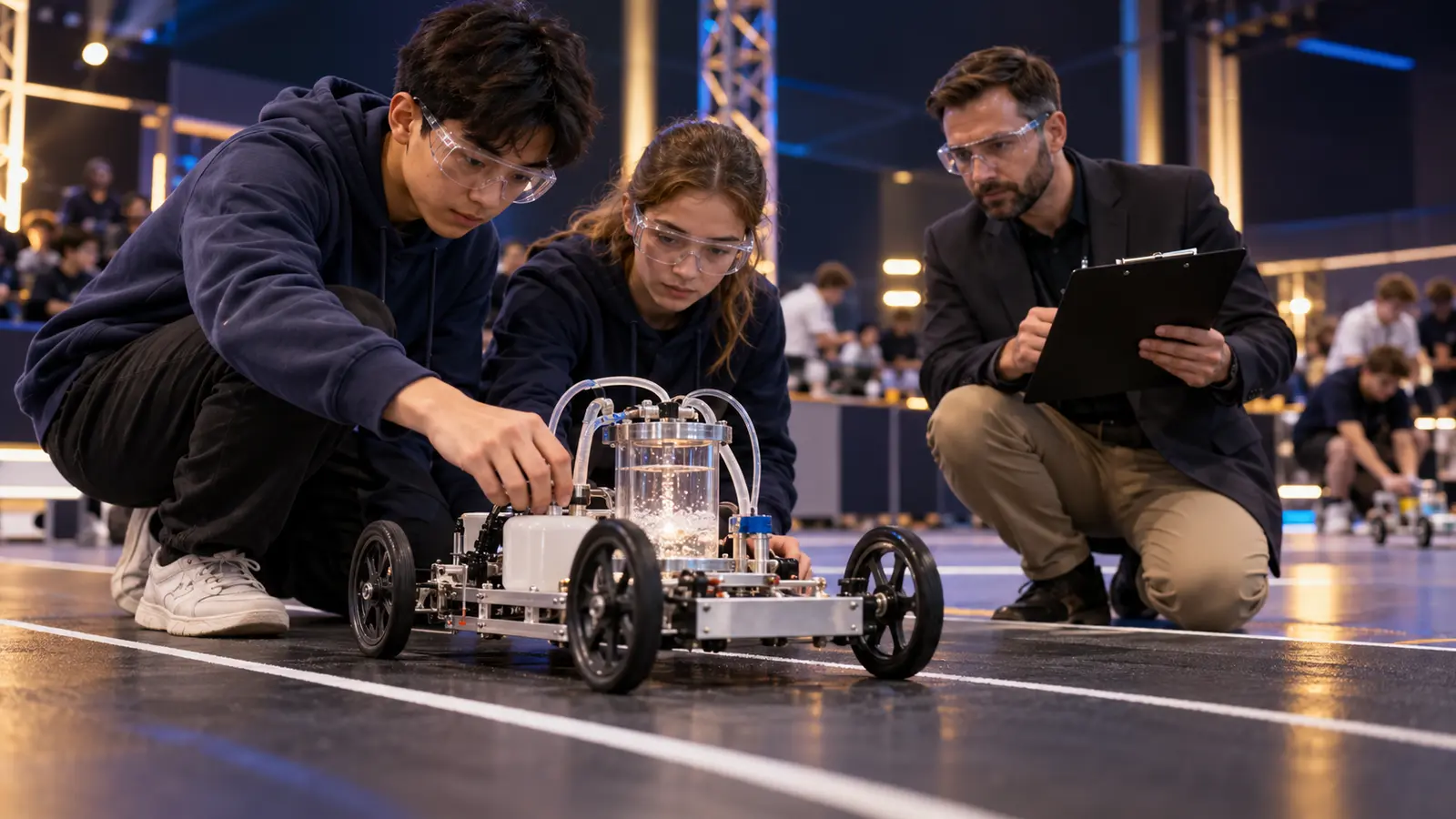
Chemecar demonstrates how safely and predictably a chemical reaction can be converted into controlled motion. Teams compete only in the route corresponding to their current education level.
Common propulsion and safety rules
- Propulsion must be produced by chemical materials and reactions. Commercial batteries, external drive sources, remote control, manual winding, pushing, wheel turning or impact-assisted starts are prohibited.
- Reactions producing toxic smoke or mist, flame, explosion risk, abnormal noise, leakage, spills or hot-gas jets are prohibited.
- Jet propulsion based on the discharge of gas or liquid is prohibited.
- After the vehicle starts, no participant may touch, push or otherwise assist it.
- Teams are responsible for transporting their vehicle, chemicals, balance, laboratory tools and protective equipment safely.
Immediate removal
Any fire, explosion, hazardous pressure event, uncontrolled leak or unsafe operation may result in immediate removal by the judges.
Primary school
Point League
The vehicle earns points through controlled progress on a five-metre course and by crossing optional coloured targets.
Vehicle limits
- All components must fit inside a 10 × 20 × 30 cm inspection box. The minimum accepted overall size is 10 × 20 × 20 cm.
- Separated components must be reconnectable by hand or ordinary tools without breaking parts or removing welds.
- Sparks, matches, open flame, lead batteries and lead-peroxide batteries are prohibited.
Run format
- Each team receives two runs. The higher run score becomes the team’s result.
- Teams have four minutes after being called to prepare behind the start line.
- Each run begins with 240 points. A vehicle completing five metres scores 240 minus its elapsed time in seconds.
- If the vehicle leaves the course before three metres, the run scores zero. Partial-distance scores apply after three metres.
- No more than three team members may prepare the vehicle; only one may follow it during motion.
- A tie is decided in favour of the team that completes five metres faster.
Partial-distance scoring
| Distance reached |
Points |
| 3.0 to under 3.5 m |
40 |
| 3.5 to under 4.0 m |
50 |
| 4.0 to under 4.5 m |
60 |
| 4.5 to under 5.0 m |
70 |
Speed penalties
The average speed over five metres may not exceed 20 cm/s. Faster vehicles receive the following deduction.
| Average speed |
Penalty |
| Over 20 up to 25 cm/s |
−40 |
| Over 25 up to 30 cm/s |
−50 |
| Over 30 up to 35 cm/s |
−60 |
| Over 35 up to 40 cm/s |
−70 |
| Over 40 cm/s |
Run eliminated |
Bonus targets
+150
Red target · 7 cm · centre of the 5 m line
+80
Yellow targets · 15 cm · 4 m line
+45
Green targets · 30 cm · corners of the 3 m line
The entire vehicle must pass over the target for the bonus to be awarded.
Primary presentation
Two team members present the vehicle, reaction, drive system, mechanics, engineering calculations, cost, environmental approach and performance curve.
30%
Chemical reaction and propulsion
25%
Gear and drive explanation
20%
Creativity, appearance and original features
15%
Safety and environmental responsibility
10%
Presentation quality
Lower & upper secondary
Performance League
The vehicle must stop as close as possible to a target line selected on competition day.
Vehicle and control rules
- Both propulsion and the stopping decision must be governed by a chemical process. Purely mechanical or electrical braking, electrical sensors and electrical current regulators are prohibited.
- An external spark or match may start a reaction only if the ignition component is removed immediately and is not part of the vehicle.
- All components must fit inside a 20 × 30 × 40 cm inspection box. The minimum accepted overall size is 10 × 20 × 30 cm.
- Non-compliant packing or reassembly adds an initial error of one metre.
- Unsafe pressure systems, uncertified cylinders and fluid-discharge systems that do not depend on a chemical reaction are prohibited.
Performance format · 60 points
- The calibration run represents 40% of the performance score (24 of 60 points); the main run represents 60% (36 of 60 points).
- Total error = (0.4 × calibration-run error) + (0.6 × main-run error).
- The target distance is drawn between 13 and 20 metres in 0.5 m steps. The water load is drawn between 100 and 500 g in 100 g steps.
- Teams have two minutes to set up. Every additional 10 seconds adds 5 cm to the absolute target error.
- The vehicle must stop within the designated zone. Leaving the zone results in elimination. Permitted departure from either end of the 50 cm start line is 10 degrees.
- No more than three members may prepare the car, and only one person may accompany it while moving.
- If scores are equal, the faster vehicle ranks higher.
Maximum run time
| Target distance |
Maximum time |
Target distance |
Maximum time |
| 13–13.5 m |
88 s |
14–14.5 m |
94 s |
| 15–15.5 m |
100 s |
16–16.5 m |
106 s |
| 17–17.5 m |
112 s |
18–18.5 m |
118 s |
| 19–19.5 m |
124 s |
20 m |
130 s |
Every additional 10 seconds adds 5 cm to the absolute target error.
Special target bonus
Two standard table-tennis balls are placed 30 cm apart at the centre of the target line. Hitting a ball reduces the measured error by 100 cm; the adjusted error cannot fall below zero.
Technical presentation · 40 points
Within the assigned time, students answer the judges’ questions about how the Chemecar was built and how its motion and stopping behaviour are controlled.
Inspection and event authority
Every vehicle must pass technical and safety inspection before each performance stage. Judges may reject or remove any unsafe, non-compliant or materially altered vehicle. Official measurements, the announced course layout and instructions issued by the judging team at the venue govern the competition.
Physical attendance is mandatory.
Bring the completed vehicle, chemicals, tools, protective equipment and presentation materials.
Register