Hand-Launched Glider Competition
Design, build and trim a safe unpowered glider for measurable distance, flight time, accuracy and landing quality.
Competition overview
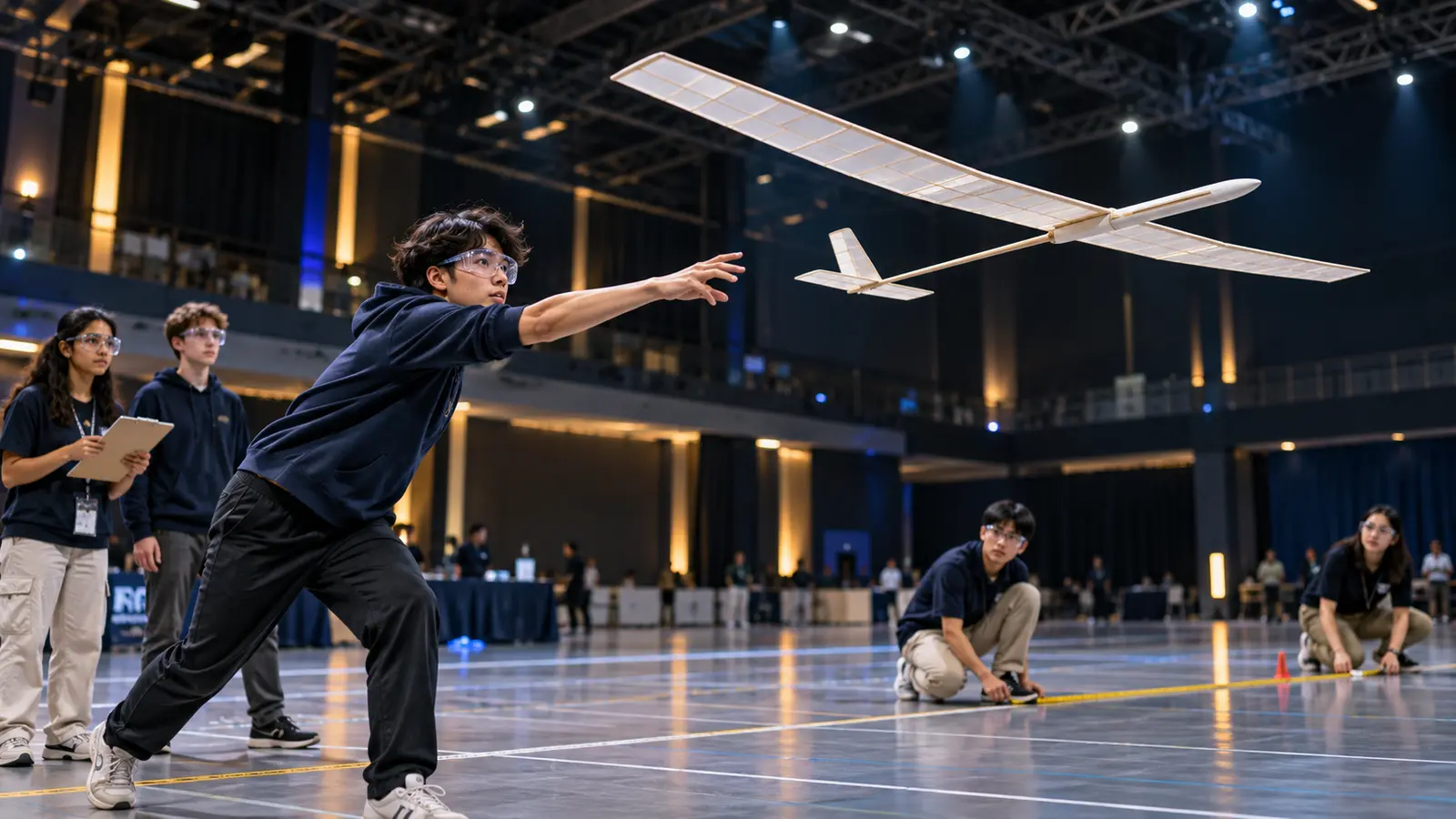
Teams engineer a hand-launched glider and demonstrate stable, efficient flight in the official competition area. Performance is measured from controlled launches, while construction quality, documentation, accuracy and safe recovery also contribute to the result.
Age group
This competition is open to students enrolled in lower-secondary or upper-secondary education. The glider must be designed and constructed by the registered team.
Technical rules
- The wingspan must be between 100 cm and 200 cm.
- The wing must use a structural construction with ribs and spars. Solid or fully filled wings are not permitted.
- Ready-made or commercially completed gliders are not permitted.
- The glider must be launched only by hand. Motors, stored propulsion and every other propulsive force are prohibited.
- Autopilot and active in-flight control are not permitted. Elevator, rudder and aileron surfaces may not be actuated during flight.
- Flapping-wing mechanisms used to generate lift are prohibited.
- No hazardous hard or metal component may remain exposed on the exterior. Any balancing weight must be secured inside the fuselage.
Flight procedure
- Each team receives three launches: one trimming or practice launch, followed—after the interval defined by the judges—by two consecutive official launches.
- Flight distance is the perpendicular distance from the launch line to the glider’s first point of contact with the ground. Sliding along the ground does not add distance.
- Lateral deviation from the reference line is measured in metres and produces a score deduction.
- A safe landing and an intact glider are considered in the final evaluation.
- If a glider reaches the end wall of the hall, the height of impact is recorded and included in the official assessment.
Scoring formula
The score is calculated from official measurements recorded by the judging team. Technical documentation is worth up to 50 points. A 10-point bonus is added when the glider’s aspect ratio is between 8 and 12.
Safety & inspection
Every glider must pass technical and safety inspection before entering the flight area. Judges may reject any aircraft that is hazardous, uses a prohibited system or does not meet the dimensional and structural rules. Instructions issued by the flight marshal and judging team at the venue must be followed at all times.